A parade of planets is set to grace our evening sky on 28 February 2026 – at least according to a number of media outlets. Six planets will align across the heavens giving skywatchers a super opportunity to view them all on the same evening.
While there is absolute truth to the numerous reports and articles that Mercury, Venus, Jupiter, Saturn, Uranus and Neptune can all be found strewn across the sky on the evening of 28 February after sunset, the reality of what you’ll be able to see might be a little less spectacular than you might have hoped for.
The star of the show – pun intended! – is undoubtedly Jupiter. Look high up in the sky towards your south or south-east at nightfall on 28 February, not far from where you’ll find the Moon, and you should easily spot Jupiter. It is bright – the brightest star-like object you’ll see in the sky that night – nestled within the constellation of Gemini.
Jupiter is bright because it is a big planet. More than 1800 Earths would fit inside this giant! It is also very reflective. Its deep hydrogen atmosphere is enveloped by a 70km cloud layer that contains ammonia ice crystals. Sunlight bouncing off the ice crystals – planets shine by the reflected light of our Sun – along with the Jupiter’s sheer size makes it a very notable beacon from our earthbound viewpoint.
Saturn, the second biggest planet in our solar system, should be another straightforward catch. You’ll find it much lower in the sky towards the south-west and west at nightfall. Look for the brightest ‘star’ you can see in this direction no more than 10-degrees above the horizon. Ideally you need a flat open view to your west to spot it.
Saturn is coming towards the end of its 2025-26 apparition. The ringed planet has been a great target on our stargazing nights since July 2025 and all the way through autumn and winter until February 2026. By the second week of March this year Saturn will be too close to the Sun to view.
Venus on 28 February this year will be a tough target. By the time it is properly dark it’ll be very low down on the western horizon and within minutes of setting out of sight. The best time to view Venus will actually be in twilight conditions after the sun has set and before it gets dark.
Venus is the brightest planet in our night sky and so can be visible as a binocular object just 20 minutes after local sunset, and visible to the naked eye 30 minutes after sunset.
Again a flat western horizon will help. If you can find Venus then Saturn will be to its upper left, and Mercury to its right.
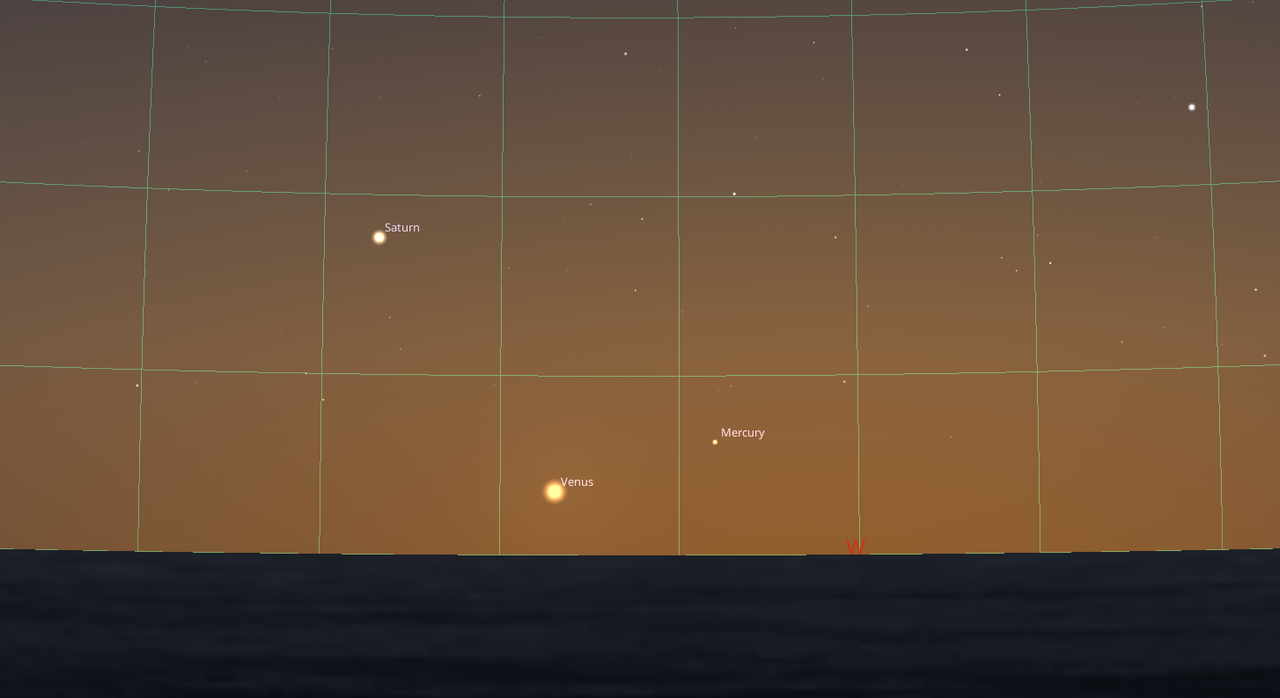
Much more challenging than Venus is Mercury. This tiny planet is much dimmer than Venus but can be found immediately to the right of Venus and slightly above. Best chance to catch it will be with binoculars and again in the evening twilight before it is dark. It’ll look like a tiny ‘star’ with a hint of pink to its colour.
It’ll be a big challenge though to see it on 28 February. For a better chance at Mercury look for it on the evening of 19 February 2026 when it is higher in the sky and more obvious to see just below a thin crescent moon.
Uranus and Neptune will not be visible to the naked eye on 28 February. Grab some binoculars though and you’ll be able to find Uranus as a tiny star near the Pleiades cluster high up in the sky, not far from Jupiter.
The challenge will be to identify Uranus. It’ll be in a field of view with lots of other stars that will look very much like Uranus, so trying to determine which point of light is Uranus can be difficult.
With a 150mm aperture telescope and a high magnification lens you’ll have a chance of catching Uranus as a tiny dull disc of light compared to the pinpoint-like stars. If you know where to look it’s a good opportunity to bag Uranus.
Neptune on the other hand is near impossible in this planetary parade. Only visible in binoculars or a telescope you’ll find it just over the right of Saturn. Its low angle in the sky and any lingering twilight makes Neptune the most challenging target of the six in the planetary parade.
Dark Sky Telescope Hire – Copyright 2016-2026. All Rights Reserved.
Page generated in 0.0003 seconds.