Mighty
Jupiter – the Biggest Planet in our Solar System – is Easy to See with the Naked
Eye. Here are 4 Great Ways to Go Beyond a Simple Naked Eye View of Jupiter and
Experience Its Full Majesty in 2026.
Jupiter is the second brightest
planet in our night sky. It shines brighter than any star, so making it an easy
spot with the naked eye. Through the first half of the year Jupiter nestles within
the constellation of Gemini and is visible in the evening sky after sunset until
the end of June 2026.
It then disappears behind the sun for a couple of months, shifting into the
constellation of Cancer, before reappearing in the morning sky ahead of sunrise
by mid-August 2026.
Seeing Jupiter for the first time
with the unaided eye is a thrill. In fact even if it is your thousandth time that
feeling never gets old! I especially love getting that first glimpse of Jupiter
in the early morning sky once it has rounded the sun. It fills me with
excitement that a new apparition has started and that I can show people a view
of Jupiter in a telescope in the months to come as we ramp up to opposition and
beyond.
But there’s more to Jupiter than
meets the (naked) eye – a lot more! Here are 4 ways for you to experience the
awe-inspiring majesty of Jupiter in 2026, whether you own a telescope or not.
1.
Grab a View of Jupiter in Binoculars
A simple pair of binoculars is a
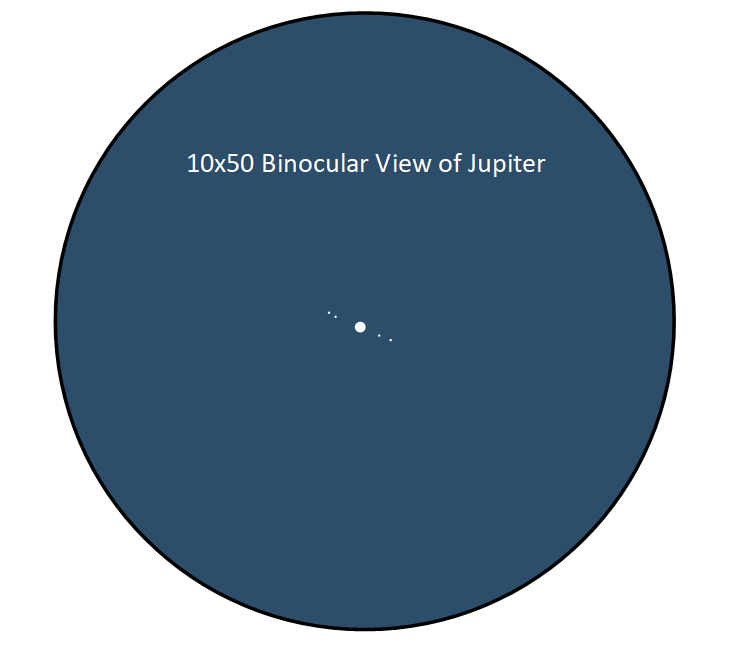
great way to elevate your Jupiter viewing experience. Even standard 10x50 binoculars
reveal Jupiter as a tiny disc of white light rather than a pinpoint ‘star’. Flanking
Jupiter you should spot up to four tiny dots of light, sometimes in a line, split
either side of the planet or on one side or the other. These are Jupiter’s
moons. Yes! With 10x50 binoculars you can see Jupiter’s moons!
Each of Jupiter’s moons orbit the
giant planet at different speeds. Io is the quickest. It orbits Jupiter every
42 hours. Callisto has the longest orbit out of the four Gallilean moons at
more than sixteen days. Between these extremes Europa goes around Jupiter every
three days and thirteen hours, and Ganymede – the biggest moon in our solar
system – orbits Jupiter every seven days.
With this wide range of orbital times
it means that a view of Jupiter each night in binoculars reveals the moons in
different arrangements around the giant planet. Personally, I think it’s really
fascinating to mentally or physically sketch the position of the moons each
night relative to Jupiter as they change position, and work out which moon is which,
with the help of some planetarium software of course!
2.
Get a Great View of Jupiter in your Own Telescope
If you own a telescope get it dusted
down and point it at Jupiter. Sounds simple, right!? I know that a few of you at
least might have tried that and perhaps struggled to get a view that you’re
happy with. In my job as a provider of stargazing experiences I hear from many
a frustrated astronomer who have a telescope but have not yet managed to get a
view of much beyond the moon with their equipment.
Fear not! Here are a few tips to get
you on the right track. First off, if you have a telescope equipment that struggle
to get on with it, just go back to basics. The joy of astronomy is in the views
not in fighting the equipment!
Pop in a wide angle lens (eyepiece) –
the wider the better. Most telescopes come with a 25mm lens and a 10mm lens or
thereabouts. Start with the 25mm (of bigger number). This gives you a wider
angle field of view and so makes objects easier to find in the first place.
If you have finderscope / sightscope /
red dot finder mounted on your telescope get this lined up in the daytime with
your main telescope view by pointing it at a distant static object – a pylon or
chimney stack for example. Eyeball the telescope’s main view in the right
direction to get the 25mm lens view centred. Then switch to your finderscope /
sightscope / red dot finder and use the adjustment pins of dials to get your
finder lined up with the main view. It’ll make your telescope set-up easier to
use in the dark to find Jupiter.
Don’t’ have a finderscope / sightscope
/ red dot finder? No worries! Simply step to the back of the telescope, crouch
down, and look along the length of the tube to see where it is pointing. If you
can position the tube so that Jupiter sits in the centre of your viewing line,
almost touching the front of the telescope as you see if from the back of the
tube then you’ll be there or thereabouts. It’s just a case of then going to the
eyepiece and making small adjustments to the direction in which the tube points
to get Jupiter centred. Also, don’t forget to use your focuser to get a really
sharp view.
So, what might you see? It depends on
the aperture of your telescope. The bigger the aperture, the bigger and
brighter the view, and so the higher the resolution of that view.
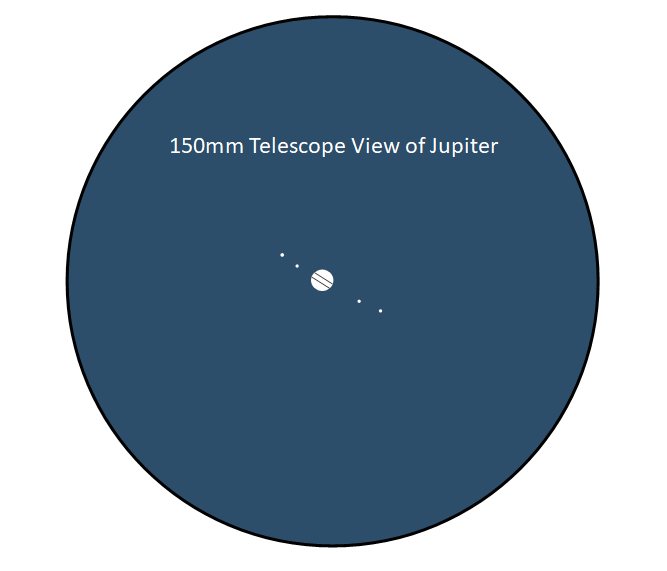
As a minimum you really need an aperture
of 150mm to see Jupiter’s atmospheric banding. Anything below that and all you
might get to see is a white disc of light flanked by up to four of Jupiter’s
moons with a 25mm lens.
So, best solution, once you’ve found
Jupiter in the 25mm, swap out the lens for one with a lower number, like a 10mm
lens. This will give you a higher magnification and might start to reveal two
subtle dark bands running across Jupiter’s disc – it’s equatorial belts.
3. Don’t have a telescope? Why not Hire One
If you don’t’ have a telescope
consider hiring one. Go for a good brand of telescope known for its quality
optics, such as Skywatcher, Meade or Celestron. Also go for APERTURE! 150mm aperture
minimum, but 200mm, 250mm or 300mm aperture will get you a much better view!
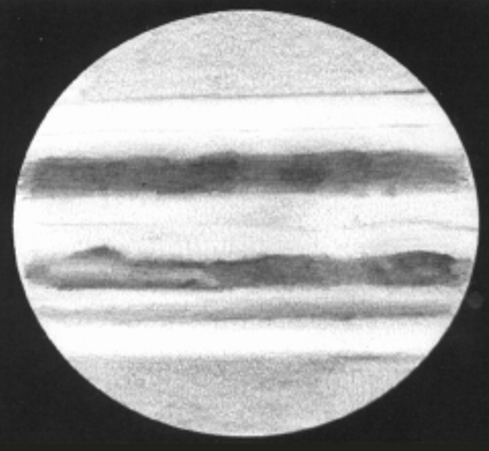
In fact a 250mm aperture reflector
design of telescope pointed at Jupiter with a 10mm lens will reveal not only
those dark equatorial belts, but other thinner belts besides along with shaded
polar regions – a really detailed view. You’ll also be able to see the Great
Red Spot storm system when it is on view.
The Great Red Spot Storm System is a
MASSIVE anticyclonic storm system in Jupiter’s cloud layers with remarkable
longevity. It was first spotted in 1665 and is still going strong today.
Varying between one and a half to two
Earth diameters in size this behemoth of a vortex has been continuously
observed by astronomers since 1831. It is only in more recent times, since
Juno’s Jupiter mission in 2016, that we’ve garnered a real appreciation of the
storm’s dynamics and placement in Jupiter’s atmosphere. We now know that the
Great Red Spot storm spirals down to a depth of more than 500 kilometres
beneath Jupiter’s visible cloud tops.
So what will you see of the Great Red
Spot in a 250mm aperture telescope? First off consider the storm system as an
almost fixed point in longitude. Jupiter spins on its axis once every 9 hours
and 55 minutes, taking the storm system into and out of view from our
earthbound viewpoint. But for a period
of about 3 hours in every 9 hours and 55 minutes the Red Spot transits across
the front of Jupiter’s disc as seen from Earth.
The storm system itself looks like a
singular dark eye looking back at you, half-nestled within the southern dark
equatorial belt and half jutting out into an adjacent lighter zone, making it
easier to see. Often it’ll have a light red or pale pink colour, but on
occasion it can look grey or simply just a white hollow with a darker rim. An
exciting visual challenge if you have the right timing!
A detailed view of Jupiter in a 250mm aperture telescope
4.
Go to an Astronomy Open Night run by your local Astronomy Group or Go on
A Stargazing Experience
Don’t have a telescope, and don’t want
to hire one? Why not get yourself along to an open night at your local
astronomy group. An internet search is sure to turn up a local astronomy
society or astronomy group not too far from you. If you catch them on the right
night with a clear sky, the folks who run the group are sure to have the right
equipment and will be delighted to show you a view of Jupiter.
If you want a better view of Jupiter
then consider going on a stargazing experience. Some providers offer group experiences where
you’ll be waiting around with others for a glimpse of Jupiter in telescope
equipment.
Alternatively, a private stargazing
experience offers a personal touch where you can take as long as you want to get
a great view of Jupiter with a variety of different magnifications, along with
in-depth explanations of the views you’re seeing.
Dark Sky Telescope Hire – Copyright 2016-2026. All Rights Reserved.
Page generated in 0.0003 seconds.